Enterprise infrastructure for AI agents
A writing system
for AI agents.
Shared, self-evolving knowledge and evidence infrastructure — sitting outside the agents, holding them to what the business actually requires.
The move from individual agent intelligence to system intelligence.
- Ontology
- Runtime graph
- Evidence
The core problem
Right instructions.
Wrong business outcome.
Execution, design and business reality drift apart. We call it the Fidelity Problem, and it is why agents are not yet trusted with work that matters.
System Design
Prompts, blueprints, policies, permissions — and the intent behind them.
Agent Execution
Non-deterministic: reasoning, memory, tool responses, a changing environment.
Business Reality
Moved by permissions, other agents, and external systems.
- 01
Execution drifts from design
Injection, tool misuse or workflow bypass take the agent down a path nobody designed.
- 02
Design drifts from reality
Tools, permissions or process have changed, and the blueprint still encodes the old assumptions.
- 03
Outcome drifts from intent
The agent follows the blueprint exactly, and the resulting business state still violates real intent.
Where this sits
Not another box.
The layer the boxes stand on.
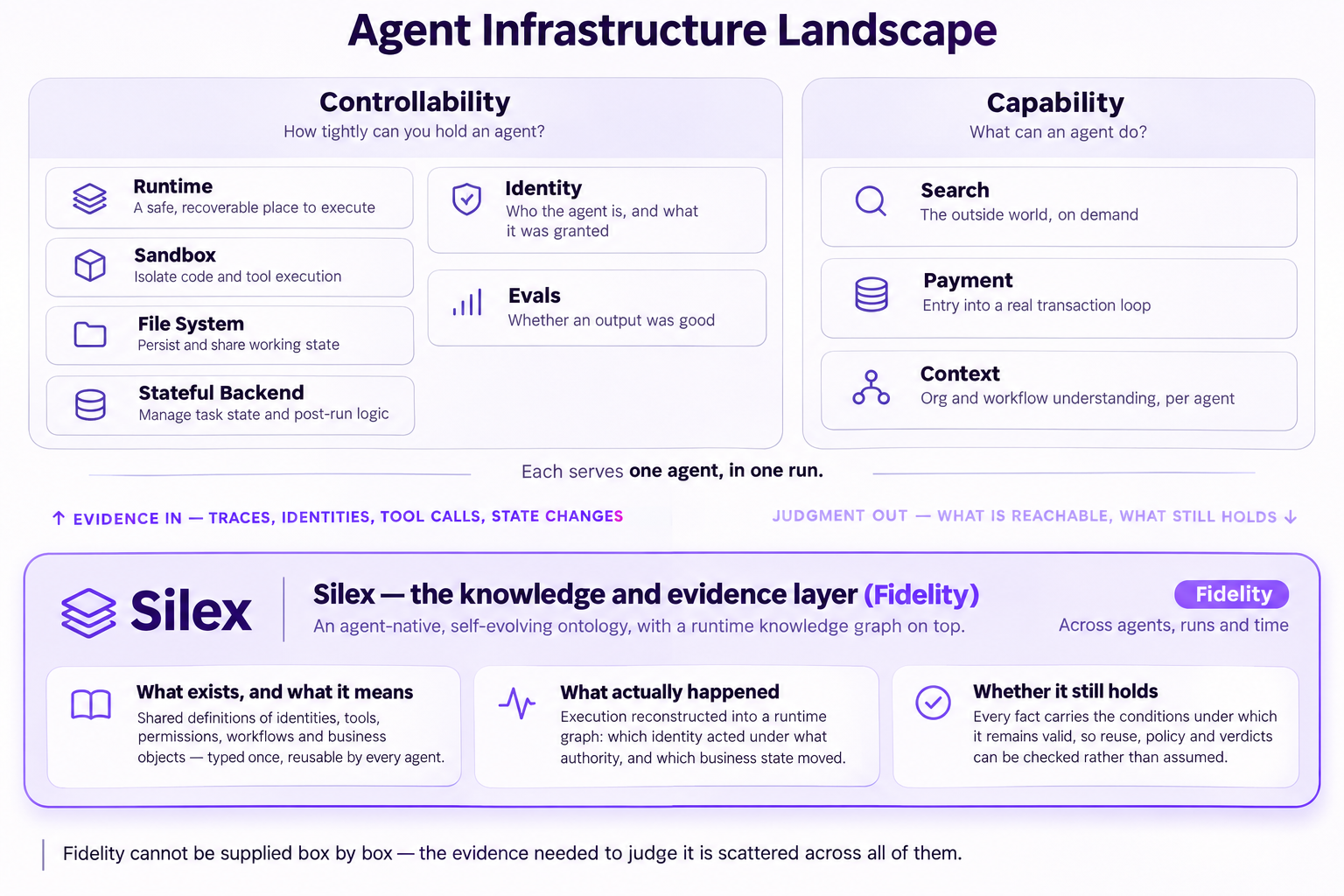
One asset, two returns
The same layer
pays twice.
Bought for assurance — and the same layer makes your agents cheaper and faster to run, because context is supplied rather than rediscovered. That second return is a line item you already pay every month.
- Cost
Context supplied, not rediscovered
Definitions, relationships and rules live in one structured layer instead of being reconstructed by every agent on every task.
- Latency
Validated paths, reused
Agents build on a path that already worked, while the context, permissions and conditions behind it still hold — rather than re-deriving every step.
- Security
Judged against what the business meant
An agent that complies with every policy can still be wrong. We connect rules, permissions and runtime evidence to what the agent did.
This is not a cache. A cache that cannot tell you whether the cached thing is still true is a liability — the validity check is the point, and the speed-up is what it makes safe.
The direction is clear.
The form is open.
We start with verification and continuous assurance: checking an agent before it ships, and judging each consequential action while it runs. We are talking to design partners now.